
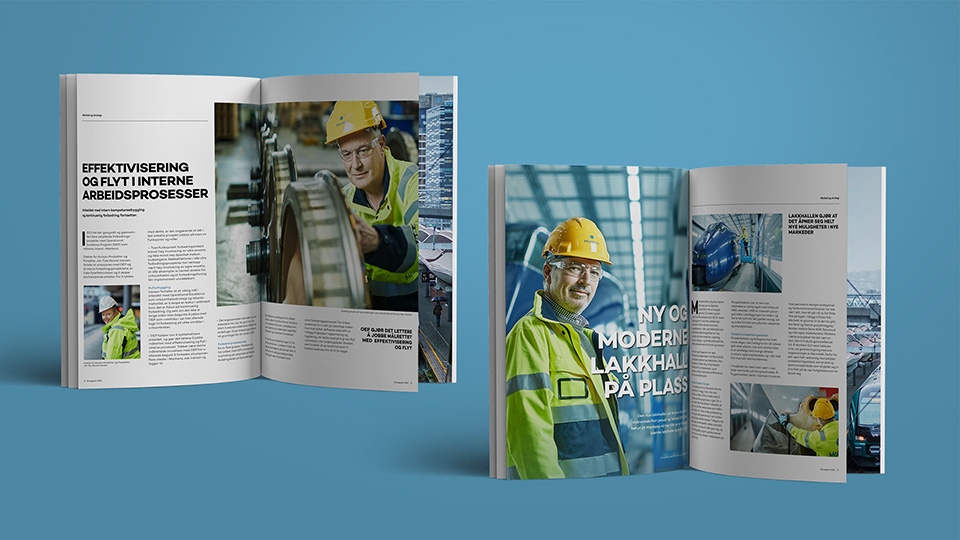
Mantena’s annual report for 2021 is now published. The railway industry suffered during the pandemic, and the effects were also felt by Mantena.
“We managed to handle a tough year without receiving COVID support. Nevertheless, we have emerged stronger because we are able to adapt,” says John Arne Ulvan, CEO of Mantena.
Mantena has had to make provisions for losses, while efficiency measures are showing results.
“The figures so far this year are positive; in that sense, the outlook appears somewhat brighter. However, we must be prepared to continue our restructuring—and manage the increased costs resulting from the war in Ukraine,” says John Arne Ulvan.
The Importance of Railway Maintenance
All trains require regular and frequent maintenance to remain operational. For travelers, this means the trains are in place and operationally safe as expected. Mantena is the largest player in train maintenance in Norway and is therefore an important part of the Norwegian railway. Mantena was previously part of the NSB family and is now owned by the Ministry of Trade, Industry, and Fisheries.
Strengthening Competitiveness
Mantena won a number of contracts in fierce competition also in 2021. At the same time, Mantena reports a negative financial result for the year. This is due to provisions for expected losses on previously entered contracts, the effects of the pandemic, and the need for further operational efficiency improvements.
“There is great potential in further innovation and optimization of the railway. We who work with train maintenance are a key player in this. With optimal maintenance, we can give trains a long lifespan and thus reduce costs for society. This is an important contribution to the green transition. Trains should be in service as much and as long as possible, before new ones need to be built. Only proper maintenance can ensure this as well as prevent the need for spare parts,” says John Arne Ulvan.
Throughout 2021, measures have been initiated to both strengthen the company’s economic development and increase competitiveness. These measures include an efficiency program which, over the next two years, will help reduce costs and significantly boost competitiveness. Additionally, the contract portfolio has been reviewed, resulting in the termination of several unprofitable agreements in 2021 and 2022.
COVID-19 and the War in Ukraine
The COVID-19 pandemic has affected the railway industry. Fewer passengers have resulted in lower revenues for train companies. The trains have run fewer kilometers. This has impacted Mantena’s revenues because train maintenance is based on kilometer intervals and revenues are tied to that. Consequently, we have had lower revenues while our costs have remained the same, partly due to readiness requirements. Mantena has not received COVID support.
Even before this, the railway reform brought about major changes for the maintenance sector as well. An altered contractual regime places high demands on cost reduction and efficiency. Maintenance companies also have to bear losses in the event of unforeseen maintenance needs or if trains operate less.
The war in Ukraine has led to increased costs in the energy sector. Now, the price of train parts is also rising. This is related to reduced availability and higher production costs.
“System efficiency improvements are necessary, and Mantena is at the forefront of this effort. We are implementing measures to save money by both reducing costs and working more efficiently. A concrete example is the spare parts warehouse. A lot of capital has been tied up in maintaining an excessively large inventory, which we have now somewhat reduced. In addition, we are exploring opportunities to achieve better terms in our procurement,” says John Arne Ulvan.
Green Transition—and Savings for Society
Mantena has taken the lead in highlighting how the maintenance regime itself can generate savings for society. This involves reviewing all maintenance requirements and comparing them to what is actually necessary at each service interval. The goal is to avoid unnecessary work and excessive consumption of parts. Additionally, this approach allows for better utilization of trains as a whole by increasing “uptime” per train set.
“This type of maintenance modernization is an initiative we have undertaken, but changes to the regime require the support of the entire industry—those who own the trains and those who operate them. Such modernization must be considered in the context of the green transition and circular economy. Ideally, trains should remain in operation and achieve the longest possible service life while we reduce consumption of spare parts. To achieve this, maintenance must be both good and efficient,” says John Arne Ulvan.