
The maintenance provider Mantena receives support from the Research Council for an important digitization project.
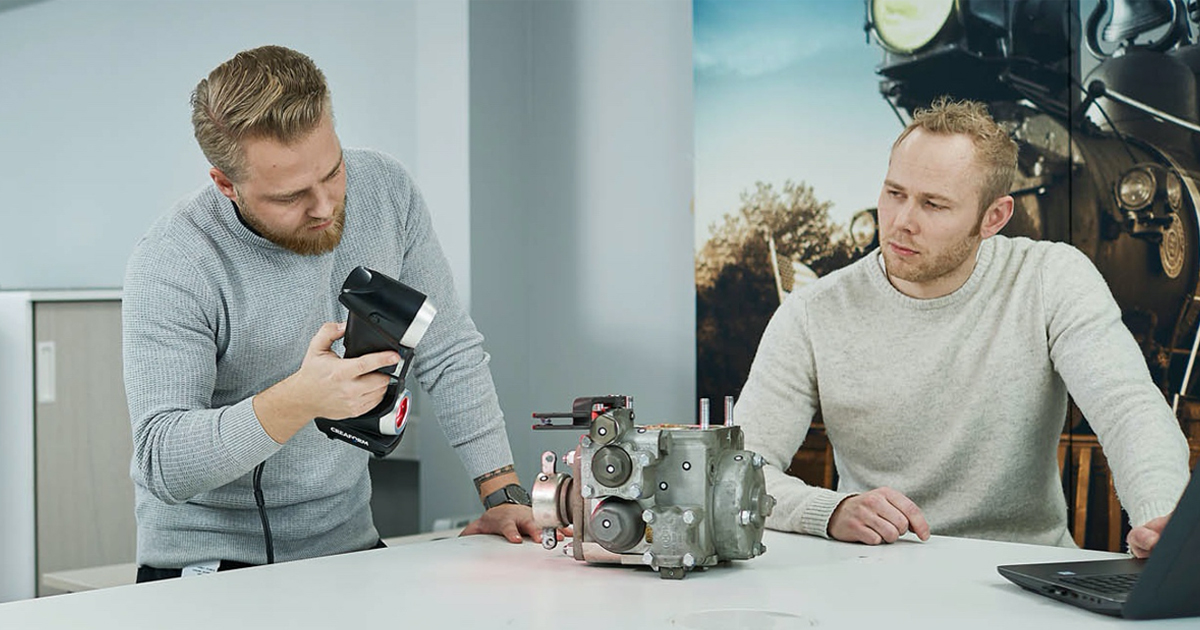
Mantena places a strong emphasis on innovation in order to deliver modern maintenance services tailored to the new railway sector. The company has now received support from the Research Council for a project in which they take a closer look at 3D scanning and digital twins of rolling stock and components.
This particular project is one of three ongoing research projects Mantena is currently running with SINTEF Digital. Initially, funding has been granted for a preliminary project that focuses on exploring the use of images, 3D laser scanning, and 3D camera technology to, among other things, build a library with 3D descriptions of components and assemblies of 3D components for systems and vehicles.
Many advantages
Project owner Tron Ranvik explains that investing in 3D scanning is appropriate for several reasons, and that re-engineering is an important area in this regard.
– A common challenge for us is that access to parts for older rolling stock can be limited or non-existent, or that lead times are very long. The manufacturer of the original part may no longer exist, making it costly to initiate new production of components. Another challenge can be insufficient technical drawings and maintenance documentation because the trains have been modified compared to their original state. With 3D scanning, we can create digital models of components and parts, which allows us, among other things, to produce new production drawings and maintenance instructions.
Digital twin
Another important objective of the preliminary project is to investigate the possibility of producing replacement parts based on digital twins. Digital twin is a widely used term in the industry in the context of digitization processes. Simply put, this involves a virtual copy of something physical that, among other things, can help increase efficiency and reduce costs by enabling the creation of better products.
Project manager Petter Lefoka believes it is important to find a functional solution to successfully implement digital twins in Mantena's maintenance work. – We want to have our components digitally available in a clear and simple system that skilled workers and people in other key roles have access to. Any continuation of the project will aim to define a functional solution for digital twins, says Lefoka.
Hope for continuation
Ranvik and Lefoka now hope for a continuation of the project. The same applies to Vibeke Skytt, senior researcher at SINTEF Digital. – This is a project that is both technologically and scientifically interesting while also having practical applications, says Skytt.